

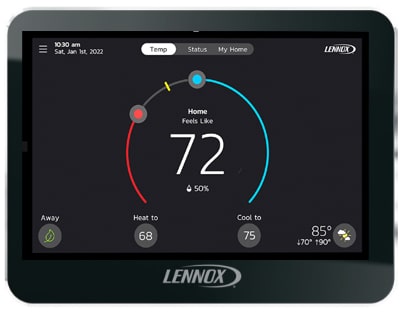
Ask ten San Diegans what temperature they set the thermostat to in summer and you’ll get ten different answers — usually followed by a story about a spouse who keeps changing it. The right answer depends on where in the county you live, because a July afternoon in Ocean Beach and a July afternoon in El Cajon are two very different events. Here’s how to find settings that keep you comfortable without donating extra money to your utility company.
Key Takeaways
- 78°F when home is the efficiency benchmark recommended by ENERGY STAR — adjust from there for comfort.
- Every degree matters. The DOE estimates meaningful savings for each degree you raise your summer setpoint.
- Coastal homes should use the marine layer — cool nights are free air conditioning if you time your windows right.
- Inland homes benefit most from scheduling — pre-cooling before the late-afternoon peak keeps comfort up and bills down.
The Baseline: What the Experts Recommend
ENERGY STAR’s long-standing guidance for summer is 78°F when you’re home and awake, a few degrees warmer when you’re away, and a setback at night. The U.S. Department of Energy adds that the smaller the difference between indoor and outdoor temperatures, the lower your cooling bill — and that each degree of setback saves a noticeable amount over a season.
Is 78 comfortable for everyone? No. Treat it as a starting point, not a rule. A ceiling fan adds a wind-chill effect that lets most people feel just as comfortable two or three degrees warmer — and a fan costs pennies per hour compared to your air conditioner.
Coastal San Diego: Let the Marine Layer Work for You
If you live west of I-5 — or anywhere the evening cool-down is reliable — your best cooling tool is free. Open windows in the evening once the outside air drops below your indoor temperature, let the marine layer cool the house overnight, and close windows and blinds in the morning to trap that cool air inside.
With that routine, many coastal homes only need the AC for a handful of true heat waves each year. When those hit, don’t be a hero: set a reasonable temperature and let the system run. A struggling, rarely-used AC that can’t keep up during a heat wave is a sign it needs maintenance — not that you need to suffer.
Inland Valleys: Schedule, Pre-Cool, Repeat
From Escondido to El Cajon to Ramona, summer afternoons regularly push into the 90s, and the marine layer’s help is limited. Here, a programmed schedule beats manual adjustment every time:
- Morning: Keep the system off or set high while the house is still cool from overnight.
- Early afternoon: Pre-cool to your comfort temperature before the worst heat (and peak electricity pricing) arrives. Your AC works far more efficiently at 1 p.m. than at 5 p.m.
- Late afternoon: Raise the setpoint a couple of degrees and coast through the peak window on the cooling you banked.
- Night: Set back up — inland nights cool off enough that most homes don’t need much help after 9 p.m.
If you’re on a time-of-use electricity plan — as most SDG&E customers now are — pre-cooling isn’t just a comfort trick, it’s a billing strategy. You’re shifting your heaviest AC use out of the most expensive hours of the day.
Away Days and Vacations
For a normal workday, set the thermostat up about 7–10 degrees from your comfort temperature rather than turning the system off entirely. A house that’s drifted to 88 takes a long, expensive recovery run to pull back down at 5 p.m.; a house held at 82 recovers quickly. For vacations of a few days or more in summer, somewhere in the mid-80s is a good ceiling — it protects electronics, houseplants, and pets you’ve arranged care for, without paying to cool an empty home.
If you have a smart thermostat, use its geofencing or schedule features so this happens automatically. The savings from a thermostat that simply remembers to set back every day, without anyone touching it, usually outrun any clever manual strategy by the end of the season.
ASI Pro Tip: “Auto” beats “On” for the fan setting in almost every home. Running the fan continuously circulates air, but it also adds heat from the fan motor and, in humid weather, re-evaporates moisture off the coil back into your house. Use “Auto” and let the system breathe.
When the Settings Aren’t the Problem
If you’ve dialed in a smart schedule and your home still won’t hold temperature — or one end of the house is an icebox while the other bakes — the thermostat usually isn’t the culprit. Common offenders include a system that’s lost efficiency to dirty coils or a low charge, leaky attic ductwork, or thin insulation that lets the afternoon heat pour in faster than the AC can remove it. Rooms over the garage or additions far from the air handler are also classic candidates for a ductless mini split instead of fighting the central system.
A good first step is an $87 complete AC tune-up — it verifies the system is actually delivering its rated cooling, so you know whether you have a settings problem or an equipment problem. And if programming your thermostat feels like defusing a bomb, ASI’s thermostat how-to guides walk through the common models step by step.
Comfort Shouldn’t Cost a Fortune
If your AC can’t keep up with a sensible setting, The White Glove Guys will find out why. Call (858) 266-0456 to schedule service anywhere in San Diego County.
Want a More Efficient Home?
ASI's insulation and energy solutions lower your bills and keep conditioned air where it belongs.
